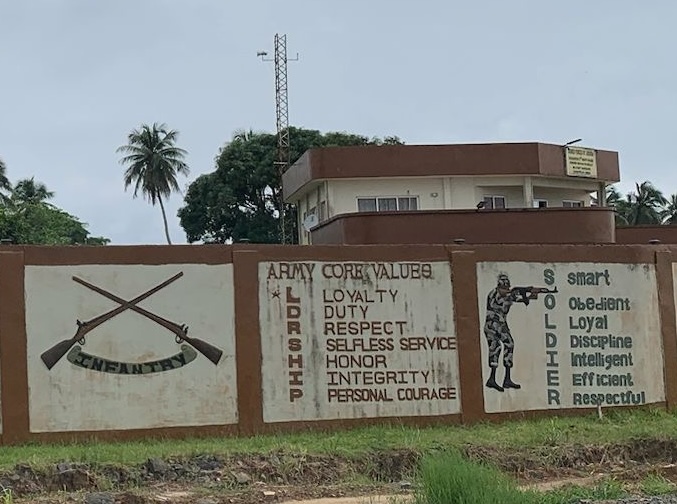
I took this photo of the 23rd Infantry Battalion of the Armed Forces of Liberia during my fieldwork in July 2025.
My research explores the role of Armed Forces in societies and how they shape and are shaped by economic, political, and societal dynamics. Military institutions are among the most powerful and consequential actors in any society given that they wield the means of organized violence and because their structure, role, and relationship with civilian populations and governments influence everything from state capacity and governance to economic development, regime stability, and social norms. By examining how militaries are organized, how they interact with civilian populations and governments, and how they participate in political and economic life, my work seeks to understand the broader implications of military power beyond the battlefield.
I have two book projects that explore the understudied phenomena of military involvement in the economy in the form of management and ownership of profit-making economic enterprises. Beyond my book projects, I have several projects that explore different dimensions of security forces. I have recently established the Security Forces, Rights & Society Lab at the Center for Non-Violence and Peace Studies at URI where I train students to collaborate on a larger project on societal militarization.
Book projects
Book 1
Militarized Markets: A Study of the Economic Role of Armed Forces
Today, there are at least 55 countries around the world whose militaries own and run various businesses such as hotels and resorts, bars, banks, consumer goods factories, transportation agencies, and many other profit-making enterprises. Military involvement in the economy is a common phenomena yet efforts to systematically analyze the causes and effects of such involvements have remained minimal. The central question of this book is: Why does the military in some countries intervene in the economy and what leads governments to permit such involvement? I demonstrate that when states undergo crises that lead them to reform the military or redefine its institution, leaders use economic involvement as a strategy to avoid bargaining failure in a civil-military bargaining process. I test my theory using an original cross-national dataset on the emergence of military involvement in the economy from 1950 to 2020.
Book 2
Capitalizing on Crisis: How Economic Downturns Shape Military’s Fortunes
Militaries differ in the extent to which they manage to operate within the economic sphere over time. Some militaries have maintained their economic involvement throughout the years and leaders in a few countries succeeded in persuading the military to completely pull out of the economy or decrease their involvement. Unsurprisingly, in many cases, the military has managed to expand its economic activities over time by establishing/taking control of new economic entities. On average, and from 1950-2024, not only did the number of military-run economic entities rise but also the scope of militaries’ economic activities broadened and involved more sectors of the economy. This book explores conditions that facilitates the militarization of the economy over time.
Military economic activities
Military Profiteering and the Erosion of Civilian Control
Forthcoming at Security Studies · 2026
With Michael Kenwick
Abstract:
Many militaries throughout the world generate significant revenue from independent activities in the private sector. These ventures operate independent of civilian oversight, are typically unrelated to defense, and the revenues they generate are not included in any official military budget. Despite their prevalence, scholars of civilian control have paid little attention to the consequences of such behaviors. We argue that regime leaders may offer militaries access to the private sector as a means of buying their favor, but these strategies ultimately weaken civilian control by altering the military’s incentives and opportunities to meddle in politics. We test this argument using cross-national data on over 2,500 firms throughout the world that are either owned or operated by the military, and further corroborate our findings with a brief analysis of the Iranian case. We find strong evidence that involving the military in the economy meaningfully weakens institutional civilian control.
🏆 Winner of the 2020 Stuart A. Bremer Award for the Most Outstanding Paper — Peace Science Society (International)
Abstract:
From producing consumer goods to managing clubs, banks, and other for-profit firms, many militaries generate revenues that are not part of the military budget and are far removed from the realm of military affairs, and have adverse consequences for societies. Despite their significance, causes and consequences of such activities are largely unexplored. This article investigates the impact of military economic activities on propensity for coups. It argues that as the military expands its role in the economy, it gains both the incentives and opportunities to stage coups. However, this effect varies by rank. Military-run enterprises function as a double-edged sword: while they provide rent-seeking opportunities that reduce the likelihood of rebellion among mid- and low-ranking officers, they also embolden senior officers, for whom economic control becomes a political stake. Leaders may use economic privileges to co-opt mid and lower-ranking officers, but as military builds more economic capital, senior officers become less dependent on civilian leadership and more likely to stage coups. Using an original dataset of over 2,800 economic enterprises owned/run by militaries for all countries from 1950–2020, I show that coup risk significantly increases as military economic involvement increases and such coups are primarily led by senior officers.
Military involvement in the economy is a crucial aspect of civil-military relations. However, the impacts of economic ventures on the rank-and-file has not been examined empirically. In this article, we demonstrate that military economic involvement decreases the risk of mutinies by providing private goods that promote rent-seeking behavior among lower-ranking soldiers. Through military-owned enterprises, soldiers access jobs, benefits and off-book revenues (tax breaks, subsidies, favorable contracts, etc.) that are unavailable to civilians. Further, military elites may use these resources to subsidize military budgets and ameliorate economic grievances in the lower ranks. Using original, cross-national data on military involvement in the economy and information on about 2,500 military-run firms, we show that militaries with a greater stake in the economy are less likely to experience mutinies than countries with no and lower rates of economic involvement. Similar patterns hold for risk of mass defection.
🏆 Winner of the 2021 Patricia Weitsman Award for Outstanding International Security Studies Section Paper — ISA 🏆 Winner of the 2021 Inter-University Seminar on Armed Forces and Society Graduate Student Best Paper Award
Abstract:
Why does the military in some countries get involved in the economy by running profit-making enterprises and what leads governments to permit such involvement? Running household appliance factories, transportation agencies, banks, hotels, etc., are indeed unrelated to national security and are far removed from the regular roles assigned to militaries. Such involvement has further implications for both politics and the economy. I argue that the process of military involvement in the economy functions as a survival strategy for leaders and a profit-making scheme for the military. Using original cross-national data on the emergence of military involvement in the economy, this research demonstrates that militaries are more likely to get involved in the economy when the military’s institutional interests are at risk and when the government has to rely on the military to maintain power. Leaders allow the military to benefit financially through economic activities in order to stay in power.
With Markus Bayer, Aurel Croissant & Nikitas Scheeder
Abstract:
In this article, we present the novel M3-dataset. This global dataset brings together 30 existing and newly developed indicators and a total of 140,000 observations on three dimensions of material, political, and societal militarization from 1990 to 2020. We introduce a novel, multidimensional concept of militarization, explain the construction of the dataset, data-collection process, and the measures taken to ensure the validity and reliability of the data. We illustrate the usefulness of the dataset for researchers by analyzing for the first time the impact of military policing as one aspect of societal militarization on violence and human rights violations at the global level. We conclude by discussing the significance of the M3 dataset and outlining how scholars in different fields and with various research interests, including (de-)democratization, armed conflict, and human development, can benefit from incorporating this dataset into their studies.
With Peyman Asadzadeh, Behzad Attarzadeh, Skip Mark & Almira Sadykova
Ongoing projects
Military Domestic Roles Project
This project builds on my prior work on military economic involvement and expands the scope to examine all the other domestic roles militaries take on. Armed forces around the world are increasingly taking on responsibilities such as law enforcement, education, environmental management, public health, infrastructure development, and domestic security. I conceptualize this broader phenomenon as Military Domestic Roles — the expanding presence of the military across all areas of governance. My pilot data collection across 47 countries shows that these roles have increased significantly in the past two decades, especially in the wake of 9/11 and the COVID-19 pandemic. While existing research has primarily focused on coups and direct political involvements, my goal is to generate the first comprehensive cross-national dataset (1970–2025) that captures the full spectrum of military domestic roles and to develop new theory explaining the causes and consequences of this trend. This work will advance scholarship on civil-military relations, democracy, security studies, political economy and development and provide an invaluable resource for policymakers and civil society actors.
Projects with the Cornell Gender and Security Sector Lab
As a research fellow at the Gender and the Security Sector Lab at Cornell University, I work on ELSIE Initiative, in cooperation with DCAF-Geneva Centre for Security Sector Governance, a project that aims to reform the security institutions (police, military, gendarmerie) and increase the meaningful participation of women in UN peace operations. I am the lead author of one of the ongoing projects of the Gender and the Security Sector Lab and coauthor on multiple other projects. The projects aim to understand the effect of socialization on security forces’ attitudes toward the use of violence as well as exploring the institutional differences (police vs military institutions) in explaining such attitudes. I have also contributed to the DCAF Policy Briefs that address salient issue areas in the MOWIP assessments.